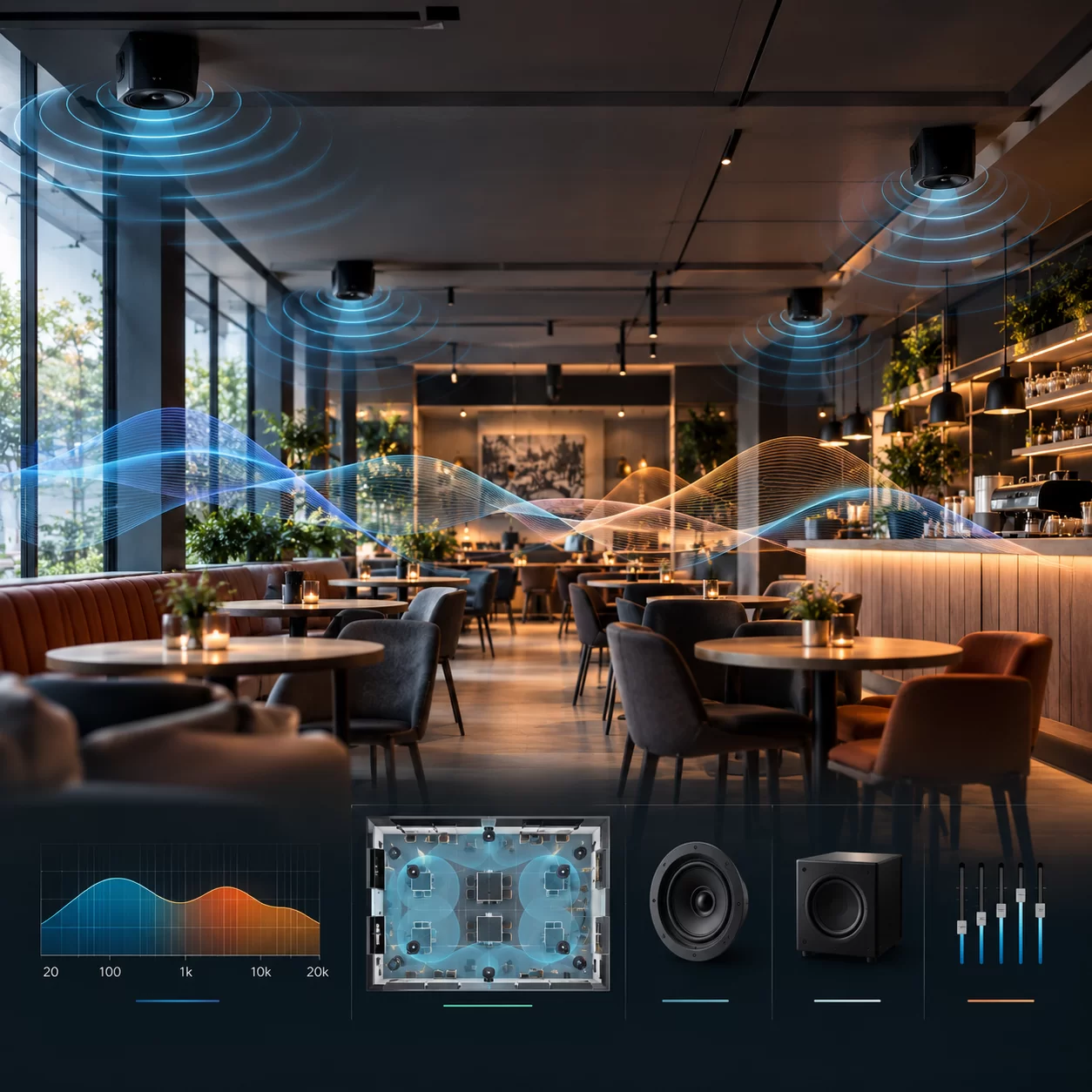
Audio System Design Guide for Commercial Spaces; The Impact of Sound Distribution and Frequency Response on Speech Clarity | Aria Azar
- Aria
- 15 شهریور 1405
- 25 بازدید
- 0 دیدگاه
Audio System Design: The Impact of Frequency Response and Sound Distribution on Speech Intelligibility
Balancing Music, Ambience, and Speech Intelligibility
In commercial and recreational environments such as cafés, restaurants, and entertainment venues, an audio system is expected to accomplish two objectives simultaneously: creating an engaging musical atmosphere while maintaining comfortable conditions for conversation.
A common approach to improving speech intelligibility is simply to lower the overall system volume. Although this can make conversation easier, it can also reduce the presence and effectiveness of the music, ultimately compromising the intended ambience of the space.
For this reason, overall sound pressure level is not the only factor that should be considered. The way acoustic energy is distributed across the frequency spectrum can have a significant impact on how clearly speech is perceived.
The principles discussed in this article assume that the overall playback level is already within an appropriate and comfortable range.
Understanding Frequency Response and Auditory Masking
Frequency response describes the range of frequencies an audio system is capable of reproducing and how effectively it reproduces each part of that spectrum.
In environments where music and conversation coexist, however, frequency response alone is not the entire issue. The distribution of acoustic energy across the spectrum also plays an important role.
When excessive acoustic energy is concentrated within a particular frequency region, it can contribute to auditory masking, a phenomenon in which a stronger sound makes another sound more difficult to detect or understand.
This is particularly relevant to speech. Human speech relies heavily on specific frequency regions for intelligibility, and excessive low-frequency energy can contribute to a less favorable listening environment.
For this reason, controlling the spectral balance of an audio system is an important aspect of sound-system design in public and commercial spaces.
Using EQ to Control Low-Frequency Energy
One of the most practical and cost-effective methods of addressing excessive low-frequency energy is proper EQ (equalization).
If the main loudspeakers are reproducing substantial low-frequency energy in addition to the midrange and high frequencies, the lower portion of the spectrum can be carefully attenuated using EQ.
The objective is not to eliminate bass altogether. Instead, the goal is to establish a spectral balance that preserves the musical character of the system while providing better conditions for speech intelligibility.
Where the system supports it, an appropriate Low-Cut / High-Pass Filter can also be used to remove unnecessary low-frequency content from the main loudspeakers.
This allows the main loudspeakers to operate more efficiently within the frequency range most relevant to their role in the system, while excessive low-frequency energy can be handled separately when required.
Balanced Sound Distribution
The second major consideration is the spatial distribution of the sound sources.
Rather than relying on a single loudspeaker or a pair of dissimilar loudspeakers to cover an entire space, multiple appropriately selected loudspeakers can be distributed throughout the environment.
A properly distributed system provides more consistent sound levels across the listening area. As a result, the system does not need to be driven excessively loud simply to make the music audible in distant areas.
This creates a better balance between musical ambience and conversational comfort.
The objective is straightforward: minimize large variations in sound level between different locations so that one area is not excessively loud while another is barely audible.
Matching the Loudspeakers
When multiple loudspeakers are used throughout a space, they should ideally have comparable frequency response characteristics and acoustic behavior.
Combining significantly different loudspeakers can result in noticeable changes in tonal balance from one area to another. This can reduce the consistency of the listening experience and make system optimization more difficult.
Using matching or acoustically compatible loudspeakers therefore helps maintain a more uniform sonic character throughout the environment.
Determining Loudspeaker Placement
Loudspeaker placement should be determined according to the dimensions of the space, the loudspeakers' dispersion patterns, mounting height, and the acoustic characteristics of the environment.
For more demanding installations, placement should be determined through proper acoustic modeling and coverage calculations.
In less critical environments, however, a simple geometric approach can provide a practical starting point. For example, the primary dimension of the room can be divided by the number of loudspeakers, with the resulting spacing used as an initial guide for positioning the units.
This approach is not intended to replace professional acoustic design, but it can be useful for relatively simple installations where highly precise coverage is not required.
Subwoofers: When Should They Be Used?
The use of a Subwoofer should be determined by the intended purpose of the space and the importance of speech during operation.
When conversation is no longer a priority and the objective shifts toward a more energetic musical experience, a subwoofer can be introduced to reproduce the low-frequency content that the main loudspeakers are not required to handle.
For environments where conversation remains important, however, excessive low-frequency energy should be avoided.
A subwoofer is therefore best treated as a controlled and independent part of the system, allowing its contribution to the low-frequency spectrum to be adjusted according to the requirements of the environment.
The Role of the Main Loudspeakers
The main loudspeakers should have sufficient capability in the mid-to-high frequency range to reproduce the primary musical information required for the space.
This approach reduces the need to rely heavily on low-frequency output from the main loudspeakers and provides greater control over the overall spectral balance.
When the main system is appropriately selected and configured, the frequency spectrum can be managed more effectively without requiring excessive low-frequency reinforcement.
Proper Loudspeaker Mounting Height
Mounting height is another important element of system design.
Loudspeakers should generally not be positioned directly at ear level or aimed directly toward the heads of seated listeners. Mounting them somewhat above ear level can provide a more appropriate distribution of sound across the listening area.
The objective is to achieve consistent and comfortable coverage throughout the space rather than creating localized areas of excessive sound pressure.
This is particularly important in cafés and restaurants, where listeners are seated at different tables and may be located at significantly different distances from individual loudspeakers.
A Cost-Effective Approach for Existing Systems
A café or restaurant with an existing sound system does not necessarily need to replace all of its equipment to improve speech intelligibility.
If excessive low-frequency energy is one of the primary issues, the first step should be to evaluate and optimize the existing system using EQ and, where appropriate, a Low-Cut / High-Pass filter.
Similarly, if the sound distribution is not perfectly balanced, adjusting individual output levels and optimizing the EQ can help reduce perceived differences between different areas of the venue.
This makes system optimization a practical first step before investing in new equipment.
In many cases, the problem may not be a lack of equipment, but rather the way the existing system has been positioned, configured, and equalized.
Conclusion
Designing an audio system for cafés, restaurants, and commercial environments involves considerably more than selecting powerful loudspeakers and setting an appropriate volume level.
Spectral balance, low-frequency control, loudspeaker distribution, driver compatibility, mounting height, and proper EQ configuration all contribute to achieving a system that can provide musical ambience without unnecessarily compromising speech intelligibility.
The goal of a well-designed sound system is not simply to produce a high sound level. It should provide consistent musical coverage throughout the environment while maintaining a comfortable acoustic condition for conversation.
Before replacing an existing system, it is therefore worth evaluating its current configuration and optimizing its placement, output levels, and frequency response.
A properly configured system can often deliver a significant improvement in perceived sound quality and speech intelligibility without requiring a complete equipment replacement.
About This Article
This article was developed through technical research, practical evaluation, and field experimentation and is the original work of Aria Azar.
Any reproduction, republication, redistribution, or use of this content without proper attribution to the author and source is prohibited.
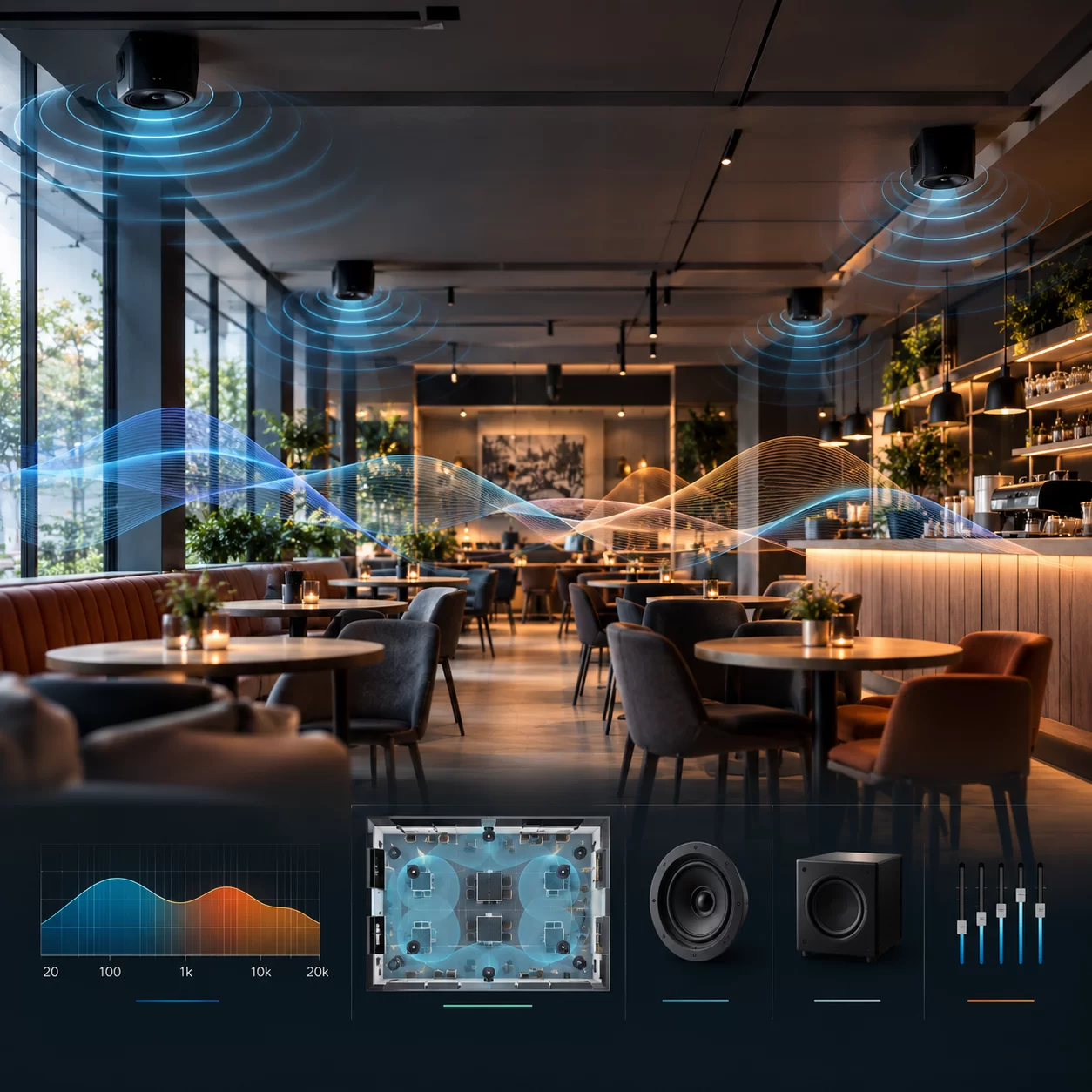 راهنمای طراحی سیستم صوتی در فضاهای تجاری؛ تأثیر توزیع صدا و پاسخ فرکانسی بر وضوح گفتار | آریا آذر
دیدگاه ها